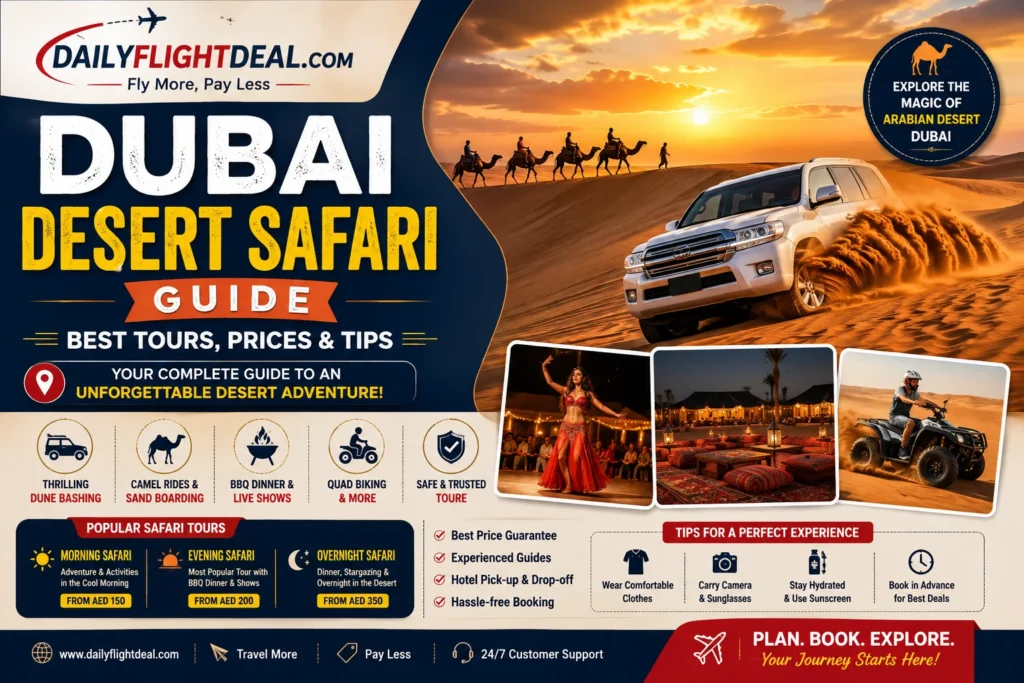
There’s a moment on every desert safari when the city noise fades, the dunes turn gold, and the only sound left is the wind moving sand across the horizon. It’s the reason a desert safari sits at the top of almost every Dubai itinerary — right alongside the Burj Khalifa and the Dubai Mall fountains. But with hundreds of operators, package names, and price points to choose from, planning one can feel more confusing than it needs to be.
This guide breaks it all down: the different types of safaris, what they actually include, how much you should expect to pay in 2026, and the practical tips that will save you money, time, and a few unpleasant surprises.
What Exactly Is a Dubai Desert Safari?
A desert safari is a guided excursion into the dunes surrounding Dubai — most commonly the Al Lahbab or Al Marmoom desert conservation areas, or the red dunes of Al Badayer near Sharjah. A 4×4 vehicle (usually a Toyota Land Cruiser) picks you up from your hotel and drives you out to the desert, where the adventure typically includes dune bashing, photo stops, and a cultural desert camp experience with food, entertainment, and activities like camel riding or sandboarding.
Safaris generally fall into three timing categories — morning, evening, and overnight — and each offers a very different experience.
Types of Dubai Desert Safaris
1. Morning Desert Safari
The morning safari is the most budget-friendly and time-efficient option, usually running for around 4 hours. It typically includes:
- Hotel pickup in a 4×4 vehicle
- Dune bashing across the red dunes
- A short stop for photos and sometimes sandboarding
- Light refreshments (tea, coffee, dates, or juice)
- Drop-off back at your hotel by late morning
This is the best pick if you’re short on time, traveling during Ramadan, or simply prefer cooler morning temperatures over a crowded evening camp. It skips the entertainment and dinner, so it suits travelers who want the dune-bashing thrill without the full cultural show.
2. Evening Desert Safari (Most Popular)
This is the classic, most-booked safari experience, running roughly 6 hours from late afternoon into the night. A standard evening safari usually includes:
- Hotel pickup around 3:00–3:30 PM
- Dune bashing in a 4×4 for 30–45 minutes
- A stop to watch the sunset over the dunes
- Arrival at a Bedouin-style desert camp
- Camel riding, henna painting, and traditional dress photo opportunities
- Live entertainment: belly dancing, Tanoura (folk spin dancing), and sometimes a fire show
- A buffet-style BBQ dinner with vegetarian and non-vegetarian options
- Unlimited soft drinks, tea, and coffee (alcohol is usually only available at premium/VIP camps)
- Return to your hotel around 9:30–10:00 PM
This tends to offer the best overall value because it combines adventure, culture, and a full meal in one package.
3. Overnight Desert Safari
For travelers who want a slower, more immersive experience, the overnight safari extends the evening format into a night spent in a desert camp, followed by a sunrise camel trek and breakfast the next morning. <cite index=”9-1″>Overnight desert safaris typically involve sleeping in a Bedouin tent followed by a sunrise camel trek and breakfast.</cite> This is a great option for honeymooners, stargazers, and anyone wanting a genuinely different pace than the typical evening rush.
4. Private Desert Safari
Every category above is also available as a private tour — meaning your vehicle and camp experience isn’t shared with other travelers. Private safaris are ideal for families, couples, or small groups who want a more personalized pace, their own driver, and often the option to customize activities or dietary choices.
How Much Does a Dubai Desert Safari Cost in 2026?
Prices vary significantly depending on the type of tour, time of day, season, and whether you book a shared or private experience. Here’s a realistic breakdown based on current 2026 pricing across major operators:
| Safari Type | Typical Price (Per Person) |
|---|---|
| Morning Safari | AED 100 – 350 (~$28–$95) |
| Evening Safari (standard) | AED 150 – 350 (~$41–$95) |
| Evening Safari (with extras: quad bike, VIP camp) | AED 350 – 500 (~$95–$136) |
| Overnight Safari | From AED 716 (~$195) |
| VIP / Luxury Safari | AED 700 – 1,500+ (~$190–$408+) |
| Private Safari (per vehicle, 1–5 guests) | AED 900 – 2,500 (~$245–$680) |
A few pricing notes worth keeping in mind:
- <cite index=”9-1″>Peak season (November–March) prices run 15–25% higher than summer rates</cite>, so if you’re traveling in winter, expect to pay a bit more than the base rates above.
- <cite index=”9-1″>Children between three and 11 years typically pay a discounted price</cite>, while most operators offer free entry for children under three.
- <cite index=”17-1″>Add-ons like BBQ dinners, quad biking, VIP seating, and private vehicles all increase the total cost</cite>, so always check exactly what’s bundled into the base price versus what’s charged separately.
- Genuinely private tours — your own 4×4 and driver, not shared with strangers — <cite index=”17-1″>generally cost between AED 1,200 and AED 2,500 per vehicle</cite>, which can actually be reasonable value if you’re traveling as a group of 4–5.
A word of caution on rock-bottom prices: you’ll often see deals advertised at AED 99 or lower. These aren’t necessarily scams, but ultra-cheap listings sometimes cut corners on vehicle maintenance, driver experience, or camp quality — and hidden extras (like charging separately for camel rides or drinks) can bring the “cheap” price right back up to standard. Booking through an established, reviewed operator is usually worth the small price difference.
What Activities Can You Expect?
Depending on the package and operator, a desert safari can include some or all of the following:
- Dune Bashing — The signature thrill ride. An experienced driver navigates a 4×4 over steep dunes in a rollercoaster-like sequence of drops and turns. Not recommended if you’re pregnant, have back problems, or get motion sick easily — most operators will let you request a gentler ride.
- Camel Riding — A short, slow-paced ride typically included at no extra cost in evening and overnight packages.
- Sandboarding — Similar to snowboarding but down a dune; usually free to try at the dune-bashing stop.
- Quad Biking / Dune Buggy — An extra-cost add-on in most packages, typically 15–30 minutes on a set track.
- Falconry Photos — Some camps offer photo opportunities with trained falcons, a nod to traditional Emirati hunting culture.
- Henna Painting — Complimentary at most camps; a nice keepsake and popular photo moment.
- Traditional Dress Photos — Try on a kandura or abaya for photos against the desert backdrop.
- Live Shows — Belly dancing, Tanoura folk dancing, and occasionally a fire-breathing performance.
- Shisha Lounges — Many camps have a designated shisha (hookah) area included in the price.
- BBQ Buffet Dinner — Grilled meats, salads, rice, and desserts, usually with vegetarian options available.
Best Time of Year and Day to Go
Dubai’s desert safari season runs year-round, but timing affects both comfort and price:
- October to April is peak season with pleasant daytime and evening temperatures, ideal for full outdoor activities. It’s also more crowded and more expensive.
- May to September brings intense summer heat, often exceeding 40°C (104°F) during the day. Morning and evening safaris are still run, but many travelers prefer the cooler overnight or late-evening options during these months, and prices tend to be lower.
- Fridays and weekends are the busiest days at desert camps. If you’d prefer a quieter, less crowded experience, book a weekday tour.
- Ramadan changes the safari schedule significantly — dinner and entertainment are typically pushed later to align with Iftar, so check with your operator if traveling during this period.
Practical Tips Before You Book
1. Dress for the desert, not the beach. <cite index=”14-1″>Clothing makes a bigger difference in the desert than most visitors expect.</cite> Loose, breathable clothing in linen or cotton works best. Long sleeves and pants actually keep you cooler than shorts by blocking direct sun, and closed-toe shoes are far more practical than sandals once you’re walking on hot sand.
2. Bring sun protection. Sunglasses, a hat, and sunscreen are essential even in the late afternoon — desert sun reflects off the pale sand and can catch you off guard.
3. Pack a light jacket for the evening. Desert temperatures drop noticeably after sunset, even in summer. If you’re on an overnight safari, this becomes even more important.
4. Confirm hotel pickup times and locations in advance. Pickup windows are usually broad (e.g., “between 2:30–3:30 PM”), and delays are common due to multiple hotel stops. Build in buffer time if you have plans later that evening.
5. Check what’s actually included before booking. Some listings advertise a low headline price but charge separately for quad biking, camel rides, or even bottled water. Read the inclusions list carefully, or book through an operator with transparent, itemized pricing.
6. Choose your seat position for dune bashing. If you’re prone to motion sickness, sit in the front seat, which experiences less side-to-side movement than the back rows.
7. Bring cash for tips and extras. Drivers, camp staff, and entertainers generally appreciate tips, and small extras like additional quad bike time are often paid for on-site in cash or card.
8. Book in advance during peak season. November through March safaris — especially weekend evening slots — can sell out days ahead. Booking a week or more in advance gives you better availability and often better prices than last-minute bookings.
9. Consider a private tour if traveling with kids or elderly family members. Shared safaris move at a fixed group pace; a private tour lets you skip activities that aren’t suitable for your group and adjust the schedule as needed.
10. Read recent reviews, not just the star rating. Look specifically for comments about vehicle condition, driver behavior during dune bashing, and camp cleanliness — these vary more between operators than the overall star rating suggests.
Is a Desert Safari Worth It?
For most visitors to Dubai, yes — and by a wide margin. It’s one of the few experiences in the city that shows a completely different side of the UAE: away from the skyscrapers and shopping malls, into a landscape that’s shaped Emirati culture for centuries. The combination of an adrenaline-filled dune-bashing ride, a genuinely beautiful sunset, and a relaxed evening of food and traditional entertainment is hard to replicate anywhere else.
The key to a great experience isn’t necessarily spending more — it’s choosing the right type of safari for your travel style, checking exactly what’s included, and booking with an operator that has a solid track record.
Final Thoughts
Whether you’re after a quick morning adventure, a full evening of culture and cuisine, or a magical night sleeping under desert stars, Dubai has a safari package to match. Compare a few operators, read recent reviews, and match the package to your budget and schedule — and you’ll come away with one of the most memorable parts of your Dubai trip.
Looking for flight deals to pair with your Dubai adventure? Check Dailyflightdeal.com for the latest fare drops to the UAE before you book your safari.